


In JavaScript, a function is a value like any other, so a function can give back another function. You then call the function it gave back, either later by a name you store it under, or straight away with a second pair of brackets: f(a)(b).
Every command and output on this page is real, run with Node.js 26.13.1 on macOS.
Syntax
Syntax
const inner = outer(a);
inner(b);

outer(a)(b);
outer(a): calls the first function, which gives back a new function.inner(b): calls that new function with its own value.outer(a)(b): the same two calls in one line. The second brackets call what the first call gave back.
See First-class function and Closures on MDN.
Prerequisites
- Node.js, to run the example. Install it from the Node.js download page.
The Example
A function, multiplier, that takes a factor and gives back a function that multiplies a number by it. It’s in a file named returns-function.js.
Step 1: Write the Code
returns-function.js
function multiplier(factor) {
  return (n) => n * factor;
}

const triple = multiplier(3);
console.log(triple(5));
console.log(multiplier(2)(21));
Step 2: Run It
Terminal
node returns-function.js
Output
15
42
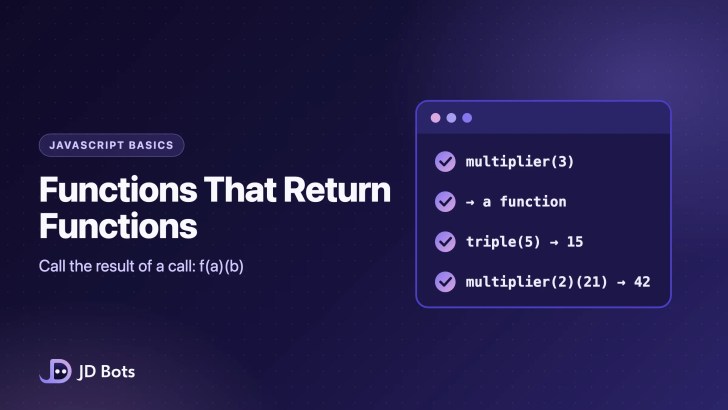
multiplier(3) gave back a function, stored as triple, and triple(5) gave 15. multiplier(2)(21) did both calls in one line and gave 42.
Common Mistakes
| Mistake | What happens | Do this instead |
|---|---|---|
Passing both values to the first call: multiplier(2, 21) | The 21 is ignored, and you get the function itself. Printing it showed [Function (anonymous)] | Call the result: multiplier(2)(21) |
FAQ
How does the inner function still know the factor?
It keeps access to the values around it when it was made, here factor. This is called a closure.
Where would I see f(a)(b) in real code?
Libraries use it to set something up in the first call and finish it in the second. TanStack Router’s createFileRoute('/about')({ … }) is one example.
Conclusion
When a function gives back a function, call the result: store it and call it later, or write outer(a)(b) to do both at once.
Additional Resources
- First-class function (MDN)
- Closures (MDN)
- Functions (MDN)
- Run Node.js scripts from the command line (Node.js docs)
JavaScript is a trademark of Oracle Corporation in the United States. Node.js is a trademark of the OpenJS Foundation.