 Skip to main content


PostgreSQL 19 came out on November 19, 2026, a week after PostgreSQL 14 reached its end of life. This post explains PostgreSQL’s versioning policy in plain words: what major and minor versions are, how often each kind comes out, how long a version gets fixes, and which one to use.
Everything here comes from the official Versioning Policy (opens in a new tab) and Roadmap (opens in a new tab) pages on postgresql.org, as they stood in November 2026.
How PostgreSQL Version Numbers Work
A PostgreSQL version number has two parts. The first is the major version, and the second is the minor version:
| Version | Major | Minor | What it is |
|---|---|---|---|
| 19.0 | 19 | 0 | The first release of PostgreSQL 19 |
| 18.7 | 18 | 7 | PostgreSQL 18 after its seventh round of fixes |
This two-part form started with PostgreSQL 10. Before that, the first two numbers together made the major version (9.5, 9.6), and the third number was the minor version: 9.6.24 is 9.6 after its 24th round of fixes. You only meet those numbers on very old servers.
Major Versions: New Features About Once a Year
The PostgreSQL Global Development Group releases a new major version about once a year. A major version brings new features, and it can change the way the server stores data on disk.
That’s why moving to a new major version is a real upgrade. A new major version can’t simply use the data folder of an older one, so you upgrade with the pg_upgrade tool, or by dumping your databases and loading them into the new version. You can jump from an old major version straight to the newest one, without the versions in between, but the official page recommends reading the release notes of every version you skip.
The next major version, PostgreSQL 20, is planned for September 2027.
Minor Versions: Fixes at Least Every Three Months
Every supported major version gets a minor release at least once every three months. Minor releases contain only fixes: for common bugs, for security problems and for data corruption. They never add features.
The regular dates are the second Thursday of February, May, August and November. The next ones are:
- February 11, 2027
- May 13, 2027
- August 12, 2027
- November 11, 2027
When a critical bug or a security problem can’t wait, the PostgreSQL team can also release a fix between these dates.
A minor update is small. It keeps the data folder as it is: you stop the server, install the new programs and start it again. Read the release notes first, though, because a fix can occasionally need an extra step.
Tip: The PostgreSQL team recommends always running the latest minor release of your major version. It considers updating less risky than staying on an old minor release.
How Long Each PostgreSQL Version Is Supported
Every major version is supported for 5 years after its first release, and gets the minor releases above during that time. At the end it gets one final minor release, and then it’s unsupported, or end of life: no more fixes arrive, security fixes included.
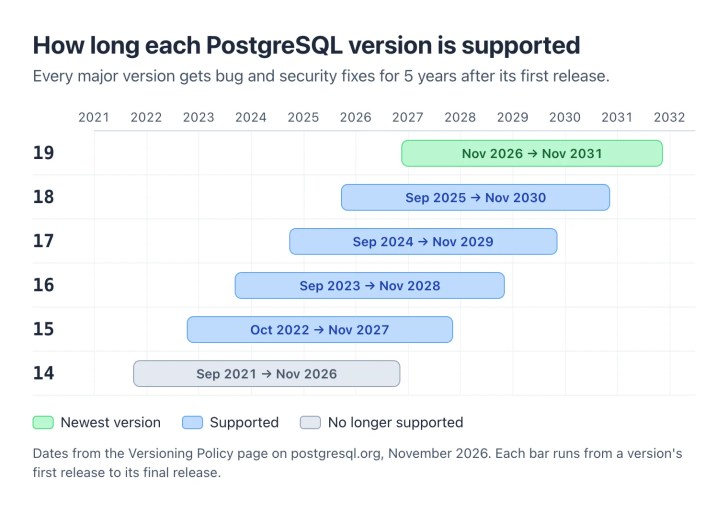
These are the versions you’re most likely to meet, with their dates from the official table:
| Version | Latest minor release | First released | Final release | Supported |
|---|---|---|---|---|
| 19 | 19.0 | November 19, 2026 | November 19, 2031 | Yes |
| 18 | 18.7 | September 25, 2025 | November 14, 2030 | Yes |
| 17 | 17.12 | September 26, 2024 | November 8, 2029 | Yes |
| 16 | 16.16 | September 14, 2023 | November 9, 2028 | Yes |
| 15 | 15.20 | October 13, 2022 | November 11, 2027 | Yes |
| 14 | 14.25 | September 30, 2021 | November 12, 2026 | No |
PostgreSQL 15 is the next to go: its final release is planned for November 11, 2027.
Which PostgreSQL Version Should You Use?
- Starting something new: use the newest major version, PostgreSQL 19. It’s supported until November 2031, longer than any other version, and it’s the one the PostgreSQL Tutorial uses.
- Already running PostgreSQL: stay on a supported major version, and keep it on its latest minor release.
- On PostgreSQL 14 or older: your version gets no more fixes. Plan an upgrade to a supported major version, ideally 19.
To see which version a server runs, connect with psql and run SHOW server_version;. The install guides for macOS and Ubuntu show it with real output.
Common Mistakes
| Mistake | What happens | Do this instead |
|---|---|---|
| Putting off minor updates because they sound like big upgrades | The server keeps running with bugs and security problems that are already fixed | Install each minor release. It keeps your data folder as it is. |
| Staying on a version after its final release | No more fixes arrive, security fixes included | Upgrade to a supported major version before the final release date. |
| Updating without reading the release notes | You miss an extra step that a fix needs | Read the release notes of the new minor release first. |
FAQ
How often does PostgreSQL release a new version?
A new major version about once a year, and minor releases with fixes at least every three months.
When does PostgreSQL 19 reach end of life?
Its final release is planned for November 19, 2031, five years after its first release on November 19, 2026.
Is PostgreSQL 14 still supported?
No. Its final release came out on November 12, 2026, and it gets no more fixes.
Can I skip major versions when I upgrade?
Yes. You can upgrade straight from an older major version to the newest, for example from 15 to 19. Read the release notes of every major version in between first.
Does PostgreSQL have LTS versions?
No. Every major version gets the same five years of fixes, so there’s no separate long-term support version to pick. The newest major version simply has the most time left.
Conclusion
PostgreSQL releases a major version with new features about once a year and supports each one for five years, with minor releases of fixes at least every three months. Use the newest major version for anything new, keep every server on its latest minor release, and upgrade before a version’s final release. The free PostgreSQL Tutorial for Beginners uses PostgreSQL 19 throughout.
Additional Resources
- PostgreSQL: Versioning Policy (opens in a new tab)
- PostgreSQL: Roadmap (opens in a new tab)
- PostgreSQL: Release Notes (opens in a new tab)
- PostgreSQL 19 Released! (opens in a new tab)
- PostgreSQL 19 documentation: Upgrading a PostgreSQL Cluster (opens in a new tab)
- PostgreSQL 19 documentation: pg_upgrade (opens in a new tab)
Related
- PostgreSQL Tutorial — Part 1: What Is PostgreSQL? Databases, Tables and SQL Explained
- Is PostgreSQL Free for Commercial Use? The PostgreSQL License Explained
- How to Install PostgreSQL 19 on macOS
- How to Install PostgreSQL 19 on Ubuntu
Postgres, PostgreSQL and the Slonik Logo are trademarks or registered trademarks of the PostgreSQL Community Association of Canada, and used with their permission.


0 comments